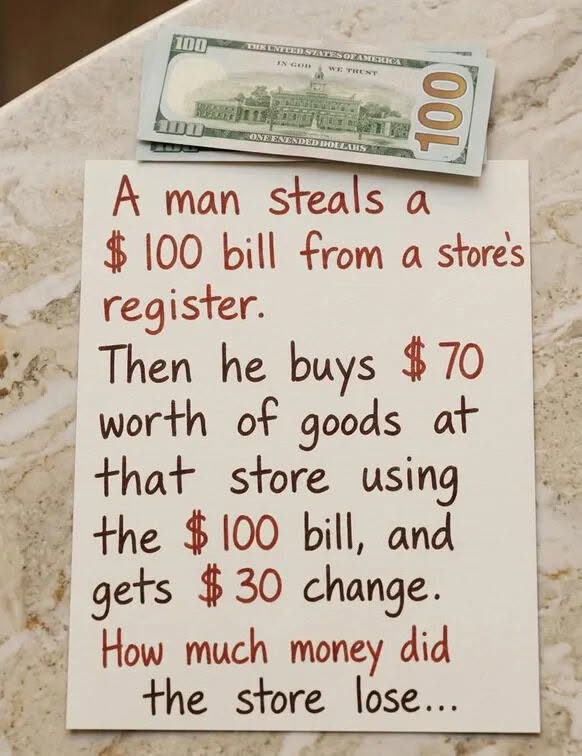
One simple math riddle has sparked heated debates across dinner tables and social media feeds for years. Imagine a local shopkeeper discovering that a man quietly took a $100 bill straight from the cash register. Moments later, that exact same individual walks back inside and hands that stolen $100 bill to the cashier to pay for $70 worth of merchandise. Without suspecting a thing, the clerk accepts the cash and hands back $30 in crisp change.Learn Math
At first glance, calculating the shop’s total financial loss seems like basic elementary arithmetic. Many confident adults immediately insist the business lost $200, adding the initial $100 taken to the $70 in goods and $30 in cash handed over at the counter. Others push back just as fiercely, claiming the shop broke completely even on the cash since the original bill went right back into the drawer.
Because this scenario blends theft with a normal retail transaction, it creates a hidden mental blind spot that trips up even sharp financial minds. Before you lock in your final number, trace every dollar carefully from start to finish. What is the real, undeniable truth behind how much money the shop actually lost?Learn Math
The actual loss occurs during the retail exchange that follows. Because the man paid using the shop’s own money, the business essentially gave away $70 worth of inventory and $30 in real change for free. When you combine the $70 in lost merchandise with the $30 cash handed over the counter, the shop’s total loss equals exactly $100.
The classic mistake people make is accidentally counting that original $100 bill twice—once when it leaves the drawer, and again when it is spent at the register. Once the stolen note returns to the till, it cancels out the initial theft, leaving only the goods and change unaccounted for. Mastering this clever logic test is a great workout for your financial brainpower—and explains why so many people get fooled by The $100 Store Riddle.Solve Puzzles
